Field note ·
Washdown, dust and heat: how environment rewrites an equipment specification
The same conveyor bought for a parcel hall and for a food plant is two different machines. Environment decides materials, ingress protection, lubrication, cleaning method and maintenance interval - and it is usually specified last.
The environment is a specification, not a context
Equipment specifications are usually written around the product and the rate, with the environment added as a paragraph at the end. In practice the environment rewrites half the bill of materials: stainless instead of painted steel, IP66 instead of IP54, food-grade lubrication, drainage, washdown-rated motors, and a maintenance interval measured in weeks rather than months.
The mistake is to treat those as options. They are consequences of a decision that should be made first: what does this machine have to survive for the next ten years. A conveyor in a washdown hall is not a conveyor with extra stainless; it is a different design with different bearings, different fasteners and a different cleaning procedure.
Wet, and what wet really means
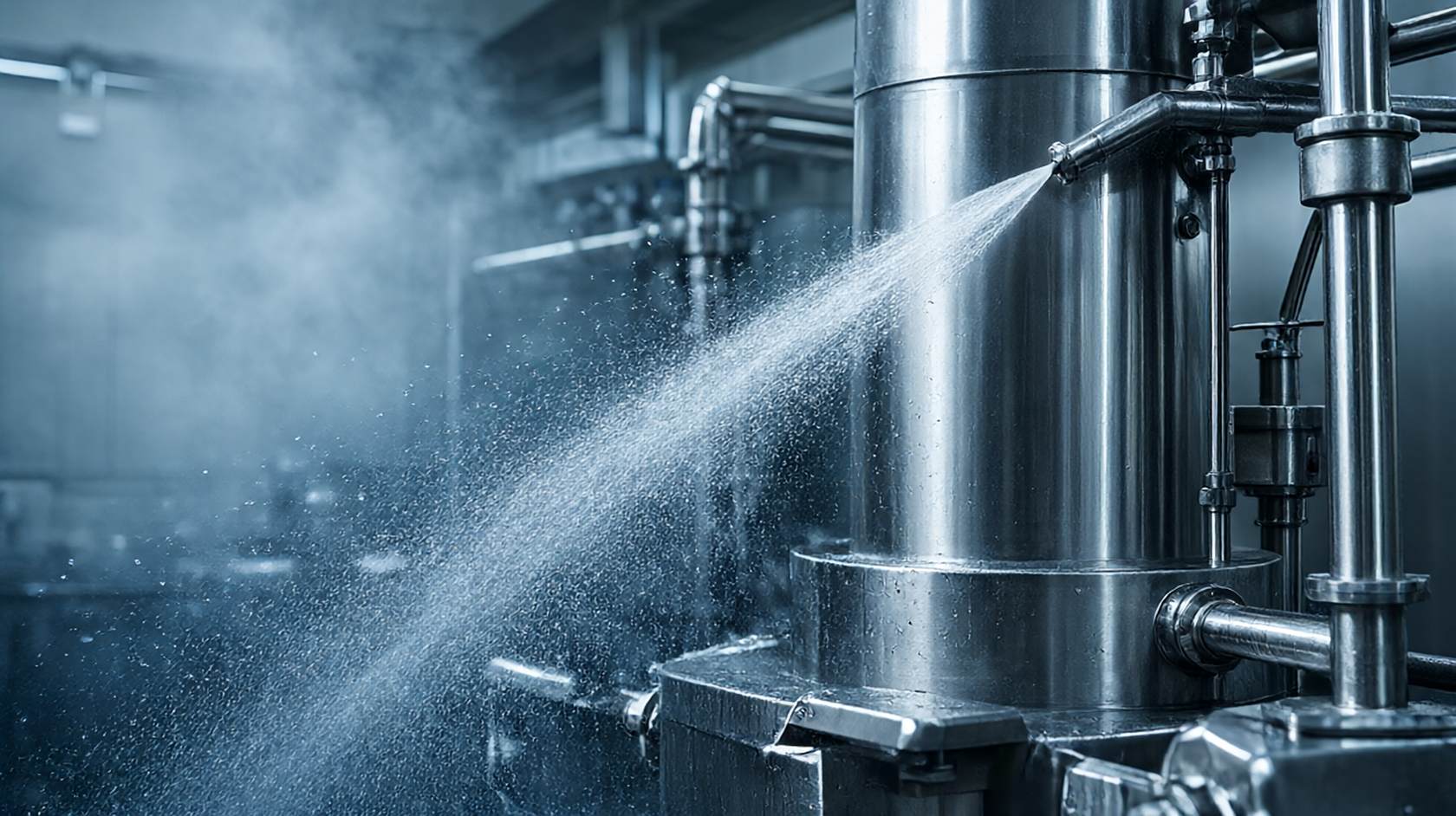
Washdown is not humidity. It is directed water at pressure, with detergent, at temperature, several times a day, plus the chemical residue that follows. The equipment must drain, the surfaces must slope, the electrics must be sealed and the bearings must be either sealed for life or lubricated with something that survives the wash.
The failure pattern is predictable: water enters a bearing housing through the shaft seal, the grease emulsifies, and the bearing fails months later in a way that looks like a manufacturing defect. The fix is a housing designed to drain and a seal that is specified for the cleaning regime, not a higher grease grade.
Stainless grade matters. 304 tolerates food and most detergents; 316 is for chloride and aggressive sanitation chemicals. The difference in cost is real and the difference in life is larger. Choosing by habit is how a plant ends up replacing a frame at year three.
Dust, and the two kinds that matter
Combustible dust is a safety problem before it is a maintenance problem. A conveyor or a dust collector handling a combustible powder needs an ignition-risk assessment, bonding and grounding, and a design that does not accumulate dust in dead corners. The regulatory framework differs by jurisdiction but the physics does not.
Abrasive dust is an economics problem. It eats seals, wears shafts and fills gearboxes. The specification responses are different: for combustible dust, eliminate accumulation and ignition sources; for abrasive dust, add exclusion seals, hard facing and a shorter inspection interval.
The cheap mistake is to specify 'dust proof' as one word. The expensive mistake is to discover after commissioning that the product is combustible and the equipment was not assessed.
Heat, cold and the materials that quietly change
Heat changes more than operator comfort. It derates motors, softens belts, changes grease viscosity and accelerates seal ageing. A conveyor designed for 25 degrees in a foundry area running at 45 will lose belt life and motor margin, and the specification should state the ambient at the machine, not the ambient in the building.
Cold is its own problem: brittle plastics, condensation on cold surfaces, grease that will not flow and controls that need enclosure heaters. A freezer application specified as a normal application fails in the first winter.
The useful discipline is to state the ambient range and the rate of change. A machine that cycles between 5 and 40 degrees has a condensation problem that a machine held at either temperature does not.
Cleaning method decides the design
Dry cleaning, wet cleaning, foam and COP are four different design briefs. A line cleaned with a pressure washer needs drainage and sealed electrics. A line cleaned with foam needs surfaces that do not trap residue in crevices. A line cleaned dry needs smooth surfaces and no horizontal ledges.
Ask the sanitation team before ordering, not after. The gap between what an equipment supplier assumes and what a sanitation procedure requires is where most food-plant conveyor rework comes from.
The corollary is that the maintenance interval follows the cleaning regime: a line washed twice a day needs a daily inspection of seals and drains, not a monthly one.
Specifying by environment class
The practical approach is to classify each machine by environment and specify the class once: dry indoor, dusty, washdown, corrosive, hot, cold, outdoor. Then every equipment item inherits the class requirements - material, IP rating, lubrication, drainage, cleaning compatibility, inspection interval.
That classification turns an argument about options into a table, and it makes the comparison between suppliers fair, because every supplier is quoting the same class.
The five environments we specify most often - parcel and warehouse, automotive and sheet metal, food and washdown, building materials and heavy load, electronics and light assembly - are described on our industries page with the parameters each one changes.
The cost of getting it wrong, in one number
The premium for the right environment class is usually 10 to 25 percent of the equipment cost. The cost of the wrong class is a premature replacement plus the downtime plus the sanitation findings plus, in a food plant, the audit consequence.
That comparison is not close. The only reason it happens is that the environment is specified last, by someone who is not in the room when the purchase order is placed.
Explosion protection and the zone question
Where a flammable dust or vapour is present, the equipment must be rated for the zone, and the zone is defined by the process, not by the equipment supplier. Getting that sequence wrong - buying equipment and then asking which zone it is in - is how plants end up with a machine that cannot be legally operated.
The practical steps are: a dust or vapour hazard assessment, a zone drawing, an ignition-risk assessment for the equipment, and a specification that states the required protection concept. Each is a document, and each is cheaper before the order than after it.
The common shortcut is to specify 'ATEX' as a word. ATEX describes a framework, not a rating. The rating is the equipment group, the category, the zone and the temperature class - and a machine without those four stated is not specified.
Corrosion, chlorides and the maintenance interval
Chlorides are the difference between stainless that lasts and stainless that pits. A plant washing with hypochlorite-based sanitisers, or near a salt store, needs 316 rather than 304, and the fasteners need to match the frame because a galvanic couple at a bolt hole is where pitting starts.
The maintenance interval follows the environment, not the calendar. A washdown line needs seals inspected weekly, drains cleared daily and lubrication checked against a food-grade schedule; a dry indoor line needs a fraction of that. Using one schedule across both is how a plant either over-maintains or under-maintains half its equipment.
The visible early warning is usually at the fasteners and the frame welds. A monthly walk with a torch, looking at bolt heads and weld toes, finds the corrosion problem a year before it becomes a structural note on an audit.
Outdoor and transitional environments
An outdoor installation adds rain, UV, wind load, temperature cycling and, in most places, dust. The specification responses are enclosure ratings, drainage, UV-stable belts and covers, corrosion protection at the fasteners, and a maintenance interval that assumes the weather will win eventually.
Transitional environments - a canopy, a loading dock, a cold store doorway - are worse than either end of the range, because they combine condensation with heat and dust with moisture. A machine specified for indoor use and installed under a canopy will corrode at the control cabinet before it corrodes anywhere else.
The useful rule is to specify the worst hour, not the average day. A machine that sees 40 degrees at noon and 5 degrees at night has a condensation problem every morning, and the enclosure heater that would have solved it costs a fraction of the cabinet replacement.
The commissioning test that proves the environment class
Acceptance should include the environment items explicitly: an IP rating check on the enclosures, a drainage test with water where washdown applies, a thermal run at the top ambient, and a check that every surface that will be cleaned can actually be reached.
Those four tests take half a day and they find the things that a normal run never will, because a normal run happens on a good day in a clean plant. The environment does not fail on a good day.
What to check
- Classify each machine by environment before the enquiry: dry, dusty, washdown, corrosive, hot, cold, outdoor.
- State the ambient range at the machine and the rate of change.
- For washdown, specify drainage, slope, seal type and stainless grade.
- For combustible dust, require an ignition-risk assessment, bonding and no accumulation points.
- Ask the sanitation team what cleaning method will actually be used.